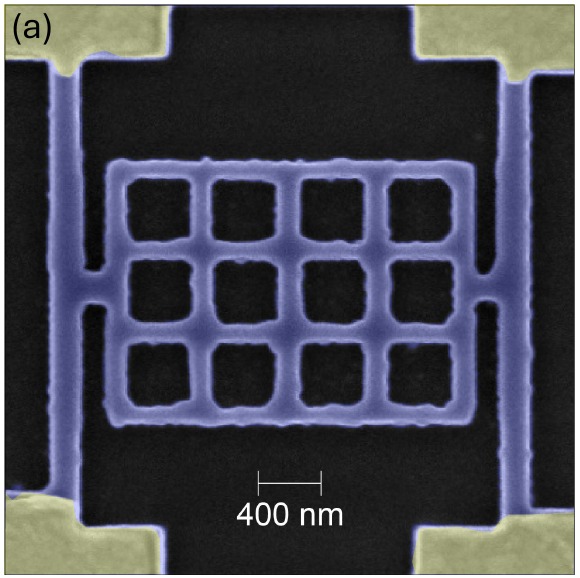
A topological superconductor should carry single electrons along its edges while its interior is superconducting. In Fe(Te,Se) rings we see both at once: an h/e interference signal from electrons travelling coherently along the edge, next to the h/2e signal of the superconducting bulk.
Key results
Two periodicities in the magnetoresistance: h/e from ballistic edge interference and h/2e from fluxoid quantization of bulk Cooper pairs.
The Aharonov–Bohm oscillations appear only below the superconducting transition and show current–field symmetry.
Their temperature dependence follows a helical Luttinger liquid model, consistent with edge states of a topological superconductor.
Cite
M. J. Balakan, S. Heidari, G. Gu, Q. Li, D. Titcombe, Z. Xiao, H. Frost, E. Bhatia, C. Kow, P. Rao, K. Watanabe, T. Taniguchi, J. U. Lee, "Aharonov–Bohm interference from coherent spin-polarized edge transport in Fe(Te,Se) superconducting rings," Submitted (2025). arXiv:2508.05030