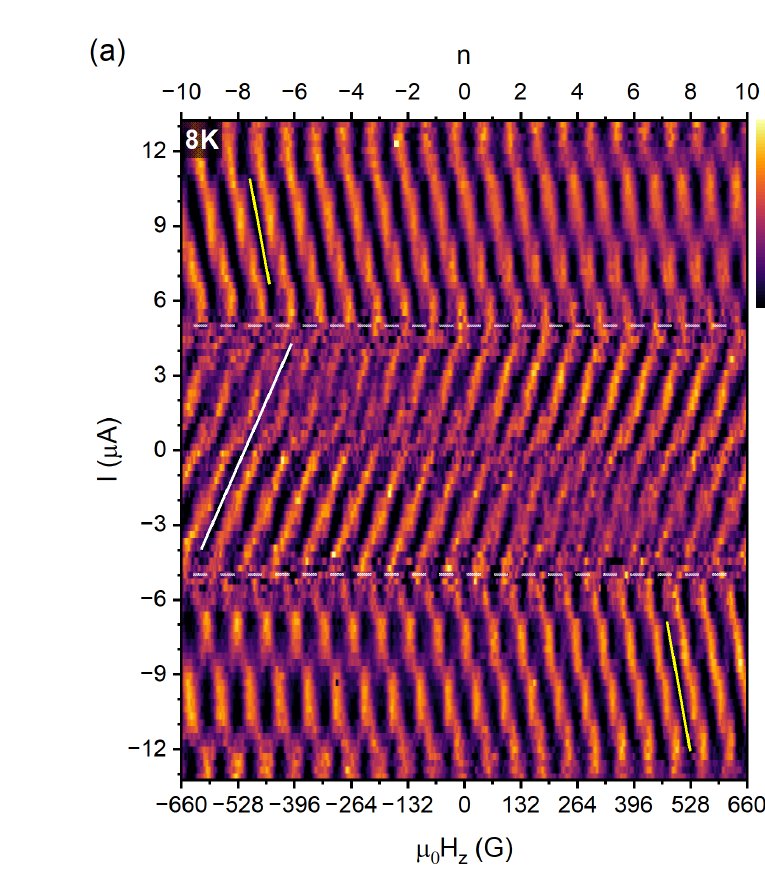
A superconductor whose Cooper pairs carry spin should be slightly magnetic on its own. In Fe(Te,Se) rings we detected that built-in magnetization: it shifts the phase of the superconducting quantum oscillations, grows linearly with the bias current, and changes direction in an unusual way with the current's polarity and size.
Key results
An intrinsic magnetic field, encoded in the phase of Little–Parks oscillations, scales linearly with the DC bias current.
The magnetoresistance shows dual flux quantization: periodic in both the external magnetic field and the DC current.
A minimal model with Rashba coupling and an anisotropic out-of-plane interaction explains the data.
Evidence for spin-polarized superconductivity at the device scale, relevant to superconducting spintronics and quantum information.
Cite
M. J. Balakan, S. Heidari, G. Gu, Q. Li, K. Watanabe, T. Taniguchi, J. U. Lee, "Intrinsic magnetization of the superconducting condensate in Fe(Te,Se)," Physical Review B (Letter), accepted (2026). arXiv:2603.08891